12.09.2012

Dajabon y Monte Cristi 30.11.12

On Nov. 30, I went on my final CIEE excursion/pasadía to Dajabon and the northeastern town of Monte Cristi. This region has been the site of many historical events in terms of Dominican-Haitian relations. Around here and other border towns, the Trujillo Regime ordered the Parsley Massacre/ La Masacre del Perejil of 1937, in which an estimated 20,000 Haitian civilians were murdered. It is said that the fate of these innocent citizens was determined by their ability to correctly pronounce the Spanish word for parsley: Perejil. Those who could properly pronounce the word with the "r" trill were allowed to live, for they had proved their Dominican identity. However, for many many Haitian civilians, speakers of French or Haitian creole, in which the "r" is not pronounced the same, their needless fate was predetermined.

Today the area is an epicenter of Dominican-Haitian relations. As a bordertown, Dajabon in particular, is a crucial element for both economies. With constant traffic across the border, Dajabon finds itself especially bustling on Mondays and Thursdays every week, when the Mercado Fronterizo de Dajabon, also known as the Bi-national market is open.

At first glance, one would assume that Haitians are the ones benefiting the most from this market. They are the ones crossing the border to sell their goods and make a profit at the market. However, as our Resident Director, Lynne Guitar, shared, it is really the Dominican economy that profits the most. Haitians must pay to utilize the space, and so a portion of their much needed profits is going straight to many of their original "benefactors."

Having already crossed the border and visited Haiti, I had an idea of what to expect at the market. Nevertheless, my actual experience was unimaginable. I've faced lots of crowds; at concerts, at stores, at theme parks. Most all are stressful, however, as I've found, travel is a sort of cure for many issues. It has helped me to overcome my germophobia and claustrophobia (both of which were mild cases accrued amidst both sterile and pro-individualist settings in the USA). Nonetheless, the overall aura of the market in Dajabon was just different. It was stressful yes, it was overwhelming yes... but it was also confusing, sensuous, and indignant. Very few smiles could be found. Customers (mostly Dominican) walked through the market and bargained with discontent vendors. The whole experience was an incredible blur of noise, touch, and odor. I walked, or rather pushed my way through the market with my friend Rae, who within our first 20 minutes there, had her sole 500 pesos stolen from her back pocket. I left much of my money behind, but still carried a few hundred pesos as well as my Minolta camera, so that I could attempt to capture the experience.

We entered the newly-built market building, and the smells of thousands of bodies became compounded. Many women, old and young, laid on tarps or on the bare ground, surrounded by an array of shoes, clothes, purses, and linens hoping to make a sale. Elsewhere, men sat atop the walls of the stalls yelling out at people passing by. I saw women and men carrying impossibly large sacks of goods on their backs, people running through the mud (lodo) of the outside area, and vendors trying to finish their bowls of rice in the midst of the chaos. Somehow, I managed to take a few pictures and to make one purchase. I bought a large red, white, and blue sweater... almost entirely futile in the Hispaniola heat, but something which I can definitely use in the States. The group reunited, feeling utterly exhausted after only an hour and a half, and we soon made our way to Monte Cristi.

It was also interesting to me to consider the source of many of the goods for sale. Most of the items, not all, were charity shop products, the unwanted products that ended up getting sent to developing countries to give to people in need. What a concept then, for me, a U.S. American to go to this market and purchase that sweater. Imagine the journey it has been on... The whole experience kind of made me reflect on the impact of both capitalism and international aid in the realm of the Dajabon market. It appears that these clothes were not used as they were originally intended when they were sent to Haiti. Instead they are now intended to make a profit, to form a source of income. Now that's certainly something to consider.

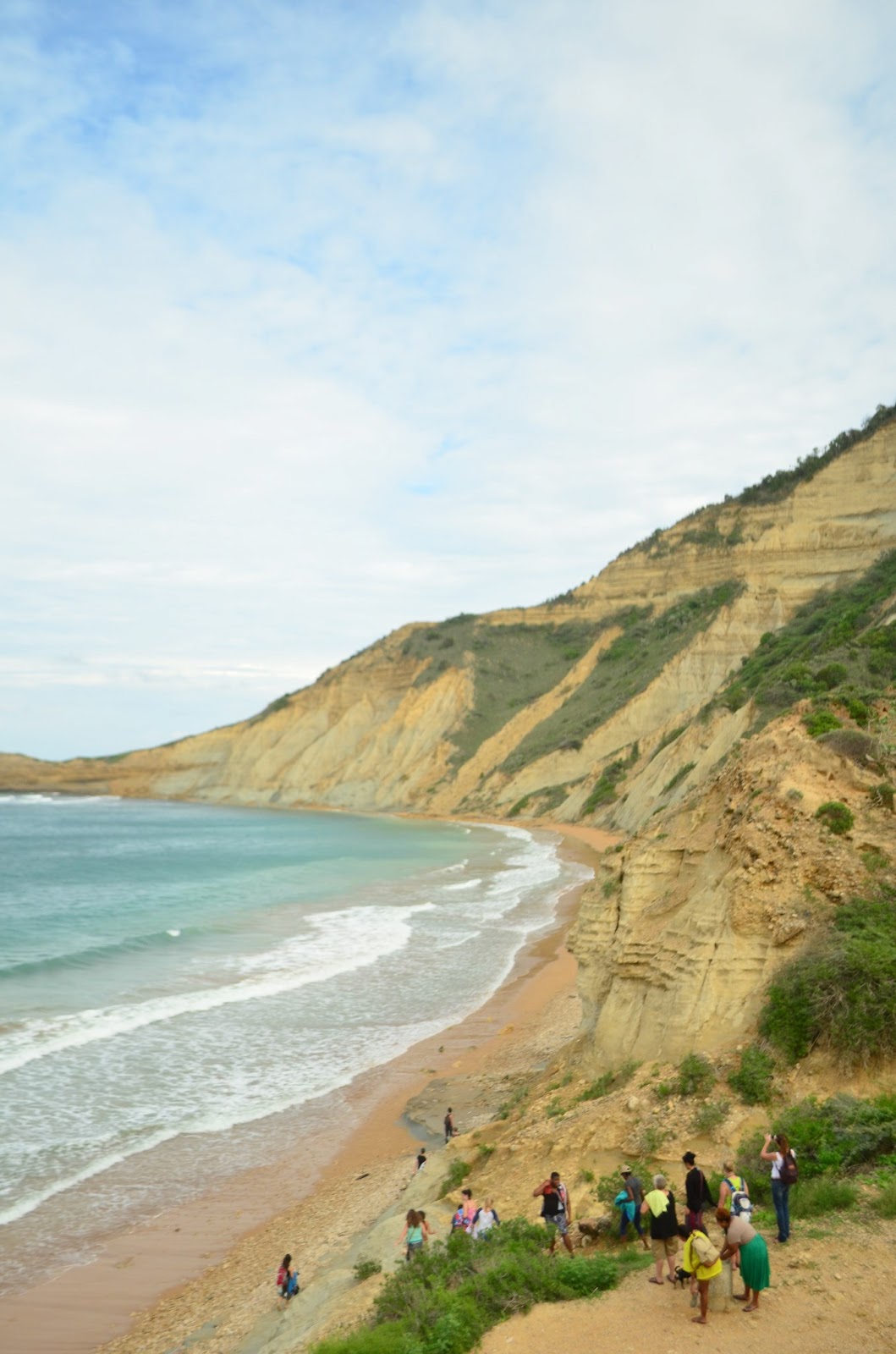
After the market, we almost had to skip out on going to the Playa detrás del Morro because of a road block (caused by Hurricane Sandy). Thankfully, we were able to enjoy this spectacular beach that I'd hoped to visit for much time. Monte Cristi was an awesome ending to the series of pasadías we enjoyed throughout the program, and once again, I was reminded of the spectacular natural beauty of the Dominican Republic and the Caribbean.

12.05.2012

Tercer mundo- un poema de disconformidad


Tercer mundo
Siempre detrás, nunca desarrollado,
Como mar y sol se queda mojado,
Mi país, mi patria ha formado su futuro,
Sus cantinas tan secas, sus espaldas desnudas.


12.02.2012

Weekend in Samana 11.23-25.12


1. Pueblo de los pescadores
2. Khemani poses on the new DR-8 highway
3. Salto al Limón
4. Aftermath of running into a barbed wire fence with my head. (Choque con un alambre de púas)
5. CIEE staff on the catamaran at Port Samana
6. Samana Bridge on a cloudy day
7. Bridge jumper at puente de Samana
8. My friend Kassy takes in the sites of the Bay
9. Kimberly gets a few shots as the catamaran sails away from the port
10/11/12. Parque Nacional los Haitises
13. Our tour guide gives us an overview of the Manglares (Mangroves) in the national park

11.20.2012

A Few Days in Haiti


I recently spent a few days in Haiti. I returned to Santiago with a new perspective and a motive for change. This is why I travel.

At the start of November 2012, I and about 16 other students made the trip from Santiago to Cabo-Haitiano/Cap-Haitïen/Cape Haiti on the north coast of Hispaniola. At around 5AM, once everyone in the group had arrived to our meeting point on campus we made our way in the guagua (bus) to the DR-Haiti border. Only three hours away, it was incredible to see the difference between these two countries which share the same island.


At the border in Dajabon, there was a constant traffic of people. I suppose this is common to most border areas, but I was especially surprised by this case. I saw tons of people crossing the border into DR, many carrying goods to sell at the nearby market. Groups of Haitian women were lined up at the DGM (La Direccion General de Migracion) waiting to be escorted to their day jobs in the Dominican Republic. According to our Resident Coordinator, these women had previously only needed a badge to cross into the DR for their work... now the process is much more lengthy and convoluted.

After a long wait at the border, sorting out the paperwork and money, we finally crossed into Haiti and made our way to Milot, the first stop on our short adventure. I will say that in my short lifetime I've interacted with lots of children from different parts of the world, but none as animated and joyful as the children I encountered in Haiti. While sitting in the guagua in Milot and waiting for our tour guides to arrive, we played with the kids standing on the sidewalk just a few feet away from our bus. One of the boys in our group got a kick out of making faces with the children and seeing their reaction. It was really the best welcome we could have received.

After driving up a steep and often muddy mountain (insert applause for the incredible Chauffeur Don Hector), we finally arrived at the  Citadelle Laferrière. The Citadelle is actually one of Haiti's most well-known landmarks. It has been recognized as the largest fortress in the Americas. Pretty astounding. The Citadelle was constructed under the leadership of Henri Cristophe, a significant figure in the Haitian Revolution, following Haiti's independence from France at the start of the 19th century.

I'll never forget the crowd that approached our guagua when we first arrived at the entrance to this historic area. Somewhere between 60 and 100 people, most selling small goods, approached our bus when they saw our bus approaching. A few people in the group bought hats and bracelets while we were there. We began our walk up to the Citadelle, led by a few tour guides from Milot. Nearly every person from our group was also accompanied by a younger Haitian male. My partner, a young man named Steven, served as a history guide, a Haitian-Creole teacher, and motivator all over the course of the hike up to the Citadelle. And what a hike it was! In the heat of midday we scaled steep hills only to find more hills to climb. The sight was well worth it. Once we arrived at the Citadelle, we split up into small groups and began our tour around the area.

Both the Citadelle and our later stop at San-Souci Palace were some of the greatest highlights of my visit to Haiti in the beginning of November. I've had the opportunity to learn about the history of Haiti and the Haitian Revolution in my university classes, and it was incredible to experience that history so up-close and to also see the pride that Haitians have for their country.

That night, everyone was very tired from the long walks around the landmarks, so we had a chance to just relax at our beautiful hotel for the evening. Located in Cap-Haitïen, the hotel where we stayed had a gorgeous view overlooking the beach. In the evening, we enjoyed hamburgers, fries, and some Haitian Prestige and passed the time away playing Mafia, riddles, and other fun games.

The next day, we made the trip to Labadee. This is a very well known beach on the north coast of Haiti, but not everyone is aware of its whereabouts. That is because many cruise liners will take their guests to this gorgeous beach and only mention that it is on the island of Hispaniola, not that it is in Haiti. We enjoyed the sun and sand, and visited two different beaches over the course of our day there.

On the ride back from the beach, I got to talking with a gentleman who started a non-profit organization in Port-au-Prince. His focus has been on feeding the over-populated, urban areas by starting small gardens. Its a program called Growing Haiti. We discussed a lot of the ways that Haiti is portrayed in the U.S. media, sources of aid that have not come through since the 2010 earthquake, and some of the harsh realities of modern-day Haiti. It was really an insightful conversation that got me thinking more deeply about the things I was seeing during my time there.

That evening, we went out to eat at a nice restaurant near the sea. I spoke with the same guy I was talking to earlier, and he told me about his travels throughout Central America, exploring the African diaspora in various countries. It was all so fascinating. After we finished up eating, we all went out to a discothèque in the city and danced to reggae, electronic music, and Rihanna. It was completely unlike any discoteca or tipico I've gone to in the Dominican Republic, but enjoyable nonetheless.

Finally on our last day in Haiti, we woke up and headed out to do some last minute souvenir shopping at an artisan market. I picked up a few carved stones and some bracelets to bring back. We also visited one last landmark, the Monument of the Vertieres. The sun was beating down on us by this point, but we took pictures and talked about the historical significance of the monument before hopping back into the guagua and heading home to Santiago.

Although it was a very short trip, I will never forget the things that I saw and learned about Haiti during these few days. I am glad that I had the opportunity to see the modern-day reality of this island nation, which so often is portrayed maliciously by U.S. media outlets. I hope to one day return, and hopefully for a longer span of time. And I also plan to share my experience in Haiti with more people, so that they too can learn about the modern-day situation there, it’s something which I feel everyone ought to know.

11.17.2012

Defining Beauty

I've been taking a class on sociopolitical and economic processes in the Dominican Republic, and most recently we've studied the rural sector of society. The more I learn, the more I'm amazed by the wealth disparity that exists within this island nation. This video gives a bit of perspective on the matter.
Defining Beauty from Roxanne Turpen on Vimeo.

11.16.2012

The Future Me Looking Back

Of my time in the Dominican Republic, I hope to one day say the following...

  • It was an irrevocable life-changing experience. No cliché. One that changed the path of the rest of my life. 
  • It gave me life.
  • It gave me room to grow and improve the self.
  • It gave me a new perspective on the world and my role in it.
  • It allowed me to explore my passions. 
  • It challenged my morality & tested my faith. 
  • It was the start of something big.
  • It did not reconfigure my cultural furniture, but simply added new pieces (new ideas, new customs, new traditions) to the room.
  • It was perhaps the first moment when I found myself able to focus on mind, body, and soul simultaneously.
  • It was the start of several years of day-dreaming & restlessness, and a journey to embracing my true character, my transient self.

11.14.2012


1. Constanza, Republica Dominicana
2/3. Aguas Blancas Waterfall/ Safari Ride in Constanza
4. Bike riding with Ryan, our Resident Coordinator in the Cordillera Septentrional
5. Nighttime bonfire in Constanza
6. Rae's Birthday Celebration at Ristorante Trinacria
7. Dominican Manicure in Los Jardines
8. Rooftop barbeque and hangout at Ryan Apartment
9. Talking with Ms. Dede Mirabal, the only surviving sister of Las Hermanas Mirabal
10/11. Constructing latrines in Dajao, Republica Dominicana (close to Monte Cristi)
12. Swimming in the waters at Taino Face
13. Dancing the night away at a Feria de los Palos in Santiago
14. My contest submission for the CIEE Study Abroad Photo Contest. Ends Nov. 15th, so go vote:

10.29.2012

Letter to an Unwanted Friend

Dear Mosquitoes,

I've given up trying to fight you. You come in all sizes, and that used to be a problem for me. But now you're all the same. Just one big biting blur. Achieving the same result as you selectively attack my right ankle and my left elbow (always in the same spot, just below my "eagle-shaped" birthmark). I've also given up trying to count the wounds I've incurred in your presence. It's because of you that I've come to celebrate Hurricane season, for the cooler weather translates to an adequate anti-itch cream. Most days I'm bothered by the heat, and in the midst of my angst you come to keep me company. An un-welcomed guest, and a lousy supporter. You are my misery. But I'll continue my coaxing, hoping you'll go back through the gaping tear in my window screen from whence you came. Until then, I'll endure the pain, and remember that it is a "compliment" that you've chosen me, my skin, my blood and no one else's.

Sincerely,
Your Favorite Sweet-blooded Human
#Thisisnotasymbioticrelationship

9.20.2012

Playa Ensenada + Cayo Arena

1. Playa Ensenada (PE)- Little boy swimming by the shore
2. PE- Lauri gives me a quick pose
3. PE- Jana & Sarah enjoying the sun!
4. PE- CIEE Liberal Arts 2012 Cohort + PUCMM Estudiantes de Apoyo
5. PE- Lobster for lunch
6.  PE- A quick game of dominoes on the beach
7. Cayo Arena (CA)- Tucker "prepares" for our snorkeling adventure. The coral was spectacular!
8. CA- Where two shores merge
9. CA- View of the Cay lined with shacks
10. CA- Our Program Director's dog, Coby, smiles for his close-up
11. CA- Coconut on the Cay